
Redesigning a council commercial property website to improve user experience
London Borough of Camden (LBC) asked us to redesign and redevelop its Commercial Properties website to deliver a more intuitive search experience and modern user interface.

The London Borough of Camden (LBC) is a London borough council serving a diverse and densely populated area that includes well-known districts such as Hampstead, King’s Cross and Kilburn. Its digital platforms provide residents, businesses and visitors with access to essential services, information and payments.
Alongside these core services, the council also manages a portfolio of commercial rental properties across the borough. The Commercial Properties website enables businesses to search for available premises, view property details and begin the enquiry process.

As a busy local authority, the London Borough of Camden relies on its digital services to support residents, businesses and visitors. The council’s websites provide an essential gateway to information, applications and payments, helping users access services quickly and efficiently.
OWA has worked with LBC since the late 1990s, delivering numerous web development projects and providing long-term technical support across multiple platforms. This long-standing relationship has built a deep understanding of the council’s systems, user needs and accessibility requirements.
When the council identified the need to modernise its standalone Commercial Properties website, OWA was asked to redesign the user interface and improve the user experience while continuing to work within the existing technical framework.
The Commercial Properties website plays an important role in connecting businesses with available rental premises across the borough. However, the existing design and user journey made it difficult for users to search for properties and navigate listings.
The London Borough of Camden wanted to modernise the experience while ensuring the platform remained aligned with the council’s wider digital identity. At the same time, the redevelopment needed to retain the existing technology stack and introduce integrations with several external tools.
- Improve the user interface (UI) and overall user experience (UX)
- Make property search and listing navigation more intuitive
- Align the design with the council’s wider digital identity
- Retain the existing technology platform where possible
- Integrate third-party services including Google Maps and ReachDeck accessibility tools
Balancing improved usability with legacy technical constraints required a careful design and prototyping process before development could begin.
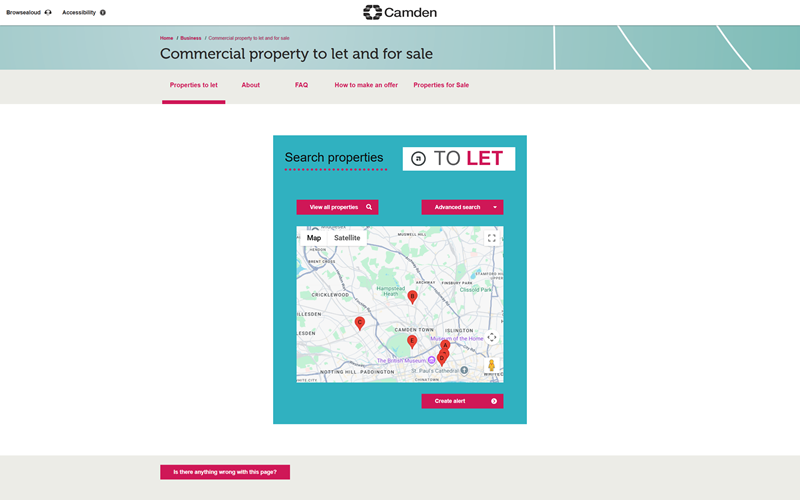
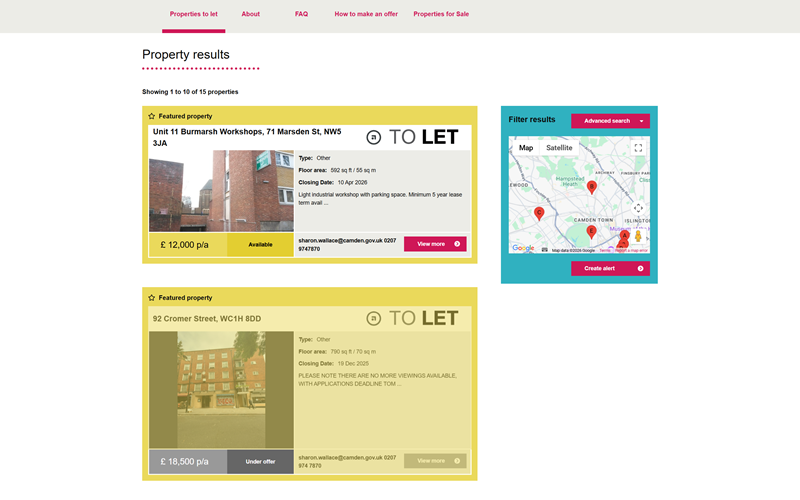
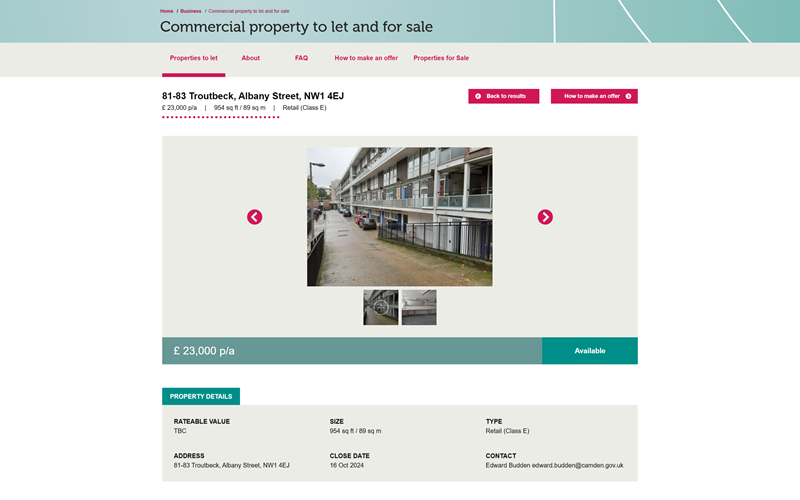
The project began with a detailed scoping phase to understand how businesses were using the Commercial Properties website and identify opportunities to simplify the search journey. From this, we mapped key user flows and designed a set of updated layouts that prioritised clarity and ease of navigation.
Wireframes and interactive prototypes were used to test the structure and usability of the new interface with council stakeholders and user testers. This collaborative process allowed the team to refine screen layouts, navigation patterns and visual design before development began.
The final website retained the existing technology platform while introducing a modernised interface and improved functionality. Integrations with Google Maps and ReachDeck enhanced both usability and accessibility, while the redesigned interface aligned with the visual identity of the wider council website.
The redesigned website delivers a clearer and more accessible experience for businesses searching for commercial properties:
- Simplified property search and navigation journey
- Modernised user interface aligned with council branding
- Improved accessibility through ReachDeck integration
- Interactive property listings with Google Maps integration
- Enhanced user experience delivered within the existing technology platform
Many organisations rely on older digital platforms that continue to perform well but require improvements to usability and design. By focusing on user journeys and prototyping changes before development begins, it’s possible to deliver meaningful UX improvements without needing a full rebuild.
- Redesign and improve user journeys on existing platforms
- Modernise UI while retaining proven technology frameworks
- Integrate mapping, accessibility and third-party tools
- Validate design changes through prototyping and testing
- Deliver improved digital experiences without disrupting core systems
Whether you’re looking to create a new application or facing legacy system challenges and performance bottlenecks, we're here to help.
UK-based design and development
Project planning and scope definition
Technical architecture recommendations
Migration strategy for legacy systems
Fully managed UK-based hosting and support